
Learn about the latest News & Events for Chicago Park District Investor Relations, and sign up to receive news updates.
Get Issuer Alerts
Add this issuer to your watchlist to get alerts about important updates.
Learn about the latest News & Events for Chicago Park District Investor Relations, and sign up to receive news updates.
News & Press Releases
Chicago, IL – Today, the Chicago Park District announced the launch of the voting period for the Citywide Participatory Budgeting (PB) program created to provide an avenue for public stake in identifying local park needs, proposing ideas for park improvements, and selecting projects with an outstanding, lasting impact on their neighborhoods. Voting runs from July 27, 2026 through August 27, 2026. Ballot boxes are accessible at Park District fieldhouses citywide, and voting is available online at chicagoparkdistrict.com/pb. Participants must be at least 13 years of age and Chicago residents to vote.
In March, the public was invited to submit ideas and/or feedback for park improvements citywide to be considered for an inaugural investment of $500,000 and officially launch the democratic selection process. This process emboldens the civic capacity of the residents that use our park spaces, ensures equitable access to participation and funding, and brings underrepresented groups to the table.
“We are excited to see our Chicago community, specifically park users and stakeholders, getting involved and providing feedback to ensure that park improvements align with community expectations and needs citywide,” said Chicago Park District General Superintendent and CEO, Carlos Ramirez-Rosa. “As we continue the process, we encourage residents to vote on the broader categories that they would like the Park District to prioritize for implementation and resource allocation."
Through this newly introduced participatory governance and community involvement process, the Park District received 1,082 project ideas that were reviewed for feasibility, cost and safety by an internal park team. The qualifying ideas were divided by the Steering Committee into four categories that are being made available to the public during this voting period.
The four categories are:
- Accessibility, Public Safety and Inclusion
o Examples include: ADA accessible playground, ramps, lighting and security cameras - Recreation Infrastructure
o Examples include: Ballfield/sports courts rehab - Permanent Fixtures and Park Amenities
o Examples include: Benches, picnic tables, bike racks - Nature and Beautification
o Examples include: Trees, pollinator gardens, nature play spaces
More specific examples will be available at chicagoparkdistrict.com/pb. Residents are being invited to rank the broader project categories that include feasible project scopes. The eligible categories with the most votes, which will include at least nine projects identified by community members as park improvement priorities, will be funded citywide. Awarded projects will be announced later this year with construction to begin in late 2026 and continue into 2027.
$1 million in TIF surplus funds pilot initiative to upgrade air conditioning systems in fieldhouses and expand cooling opportunities available citywide during extreme heat events
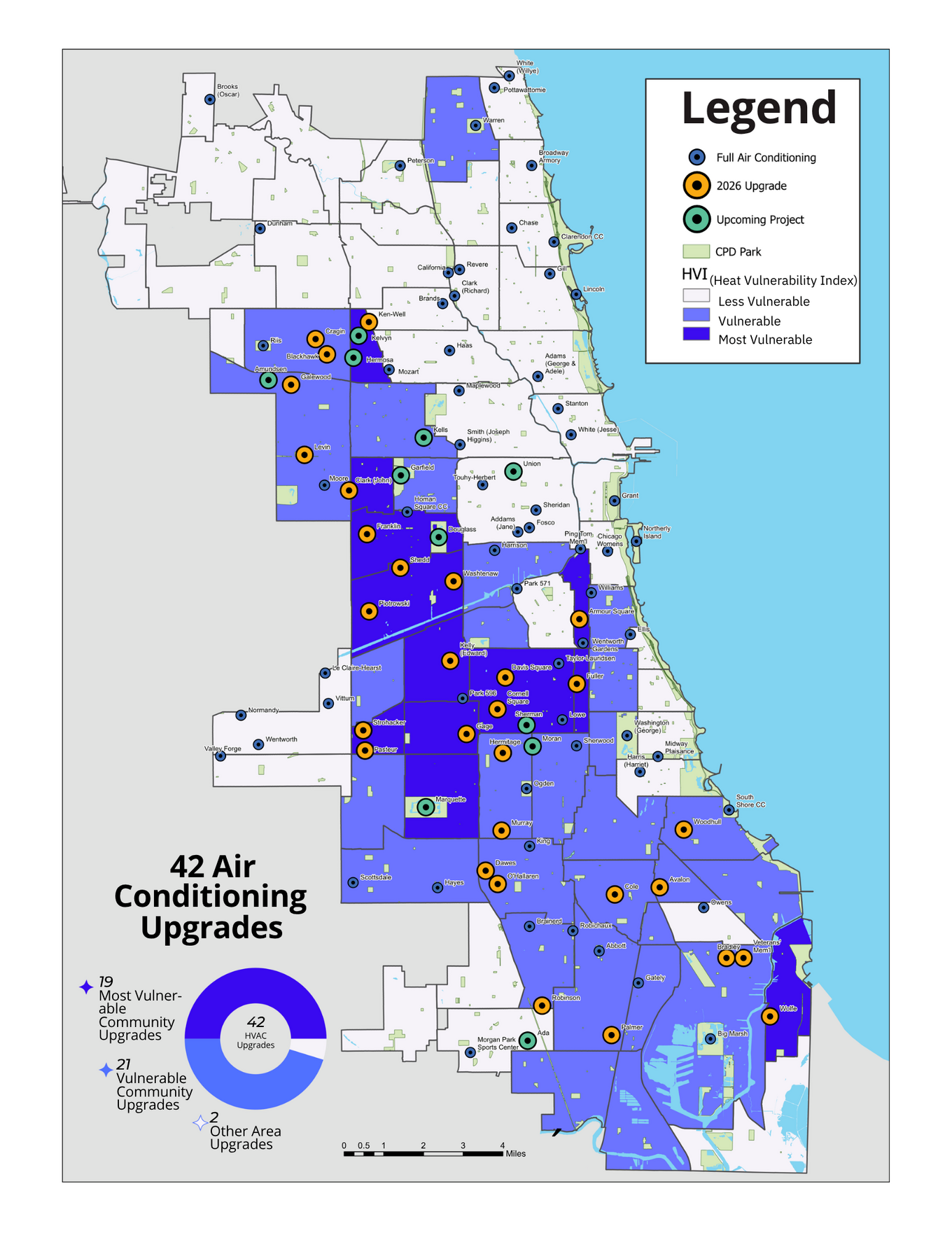
CHICAGO - The Chicago Park District announces the launch of our first phase of cooling enhancements in 42 park sites delivering $1 million in targeted park investments to community areas facing the greatest health risks during extreme heat events. The project addresses historic disinvestment and furthers the Park District’s commitment to building inclusive community spaces through equitable infrastructure improvements with support from Mayor Brandon Johnson’s historic $45 million allocation of TIF surplus to the Chicago Park District in 2026.
“For too long, communities that have faced the greatest impacts of extreme heat have also faced underinvestment in the resources needed to keep residents safe.” said Mayor Brandon Johnson. “This $1 million investment in cooling improvements builds on our commitment to deliver climate resilience, public health, and equity across Chicago. By strengthening our neighborhood parks, we are ensuring that every resident — regardless of their ZIP code — has access to safe, welcoming spaces to cool down during dangerous heat events,” said Mayor Brandon Johnson.
This pilot initiative prioritizes investments in air conditioning improvements based on the results from the Chicago Heat Vulnerability Index (HVI), developed by Northwestern University’s Buffett Institute for Global Affairs through the Defusing Disasters Working Group which incorporates research expertise from the National Oceanic and Atmospheric Administration (NOAA) and the City of Chicago.
“Public health is a core commitment for the Chicago Park District. These TIF surplus investments in air conditioning will help address systemic health inequities and transform vulnerable neighborhoods by providing reliable climate resilient and accessible public cooling spaces when and where they are needed the most,” said Chicago Park District General Superintendent and CEO, Carlos Ramirez-Rosa. “After record high-heat, flooding, and poor air quality, it’s imperative that we build more locally resilient neighborhood parks by upgrading vulnerable park infrastructure in the hardest-hit communities and using equity-focused research to connect those most impacted by extreme weather-related events to safe and comfortable public spaces to seek relief from the weather.”
The Heat Vulnerability Index (HVI) mapping tool enabled the Park District to identify 40 priority sites in heat-vulnerable communities for dedicated cooling investments, and 2 additional facility locations. The Park District prioritized 19 parks in community areas designated as “Most Vulnerable,” and 21 parks in “Vulnerable” neighborhoods, utilizing data-driven analysis. Of the total, 20 sites will be equipped with upgraded air conditioning by the end of summer 2026, and an additional 10 parks will be complete by years end. Designs for 12 larger capital projects are underway and will include cooling infrastructure, raising the total count of upgraded cooling sites to 42 upon completion.
“Extreme heat is one of the most pressing climate challenges facing our city, and we must continue investing in solutions that protect residents and strengthen community resilience,” said Chicago’s Chief Sustainability Officer and Department of Environment Commissioner Angela Tovar. “With data-driven tools like the Heat Vulnerability Index, we can better understand where support is needed most and direct resources to neighborhoods that have been disproportionately impacted by extreme weather. These cooling improvements represent an important step toward building a healthier, more climate-resilient Chicago for all residents.”
Dangerously high temperatures pose a major public health emergency for residents across Chicago. By strategically investing in cooling improvements, the Chicago Park District is helping ensure residents have safe, welcoming spaces to seek relief from the heat.
The Park District offers a variety of options to stay cool citywide that complement the City of Chicago’s broader cooling resources. At the Park District, residents enjoy access to 22 lakefront beaches, and 1 inland beach at Humboldt Park, 77 neighborhood indoor and outdoor pools, and more than 240 park-based water spray features. These features, and a canopy of over 250,000 trees that provides shade and helps mitigate flooding, also ensure residents have safe, comfortable places to seek refuge from extreme heat. During the pilot program, the Park District will be testing innovative, cost-effective cooling technologies and equipment for consideration in future expansion projects.
Today, the Chicago Park District Board of Commissioners received the District’s proposed 2026 budget. The $637.6 million spending plan which closes a projected $30 million gap deficit by focusing on three principles: finding efficiencies, generating sustainable new revenue, and investing in one-time resources responsibly. The 2026 budget makes targeted investments that advance the District’s Strategic Plan’s six goals and invest in youth and teens, accessibility and special recreation, sustainability, public safety and community wellbeing.
Chicago Park District General Superintendent and CEO Carlos Ramirez-Rosa presented the 2026 budget recommendations to the Board. The $637.6 million budget is a fiscally responsible plan that reflects a 6.5% increase from the previous year to address. Highlights of the proposed budget include targeted use of the $46 million anticipated TIF surplus to invest in the District’s pension and capital funds, including a $5 million capital investment to create Chicago Grows Together, a new fund that directs resources to deferred maintenance and equitable infrastructure solutions for parks on Chicago’s South and West Sides.
The proposed budget also invests $1.75 million in the Special Recreation Fund to expand adaptive sports, inclusion support, and ADA accessibility improvements including an elevator modernization. Moreover, the 2026 expands Young Cultural Stewards Teen programming, Lifeguard Explorers Training Program, allocates $250 thousand to replace lost Night Out in the Parks grant funding. The budget also increases staffing by nearly 15 full-time equivalent positions, supports technological and sustainability upgrades, and strengthens partnerships with sister agencies to increase public safety and community wellness.
Residents can view the Chicago Park District’s 2026 budget recommendations online at the Annual Budget Process page. Park District Board of Commissioners will vote on the 2026 budget recommendations during its regular monthly meeting on December 10th.
“The Chicago Park District’s 2026 budget supports our commitment to provide every Chicagoan with affordable programs, and access to exceptional experiences in safe, beautiful, and welcoming public spaces, while protecting the Park District’s fiscal health and ensuring we can continue serving the millions of Chicagoans who depend on our parks every day,” said General Superintendent and Chief Executive Officer, Carlos Ramirez-Rosa. “This budget closes that $30 million deficit without layoffs, service cuts, or one-time fixes by focusing on three principles: finding efficiencies, generating sustainable new revenue, and investing one-time resources responsibly. The 2026 budget does not merely preserve what we have; it builds upon it, making targeted investments in special recreation, teens, sustainability, public safety, pension and capital that advance our Strategic Plan’s six goals: Exceptional Experiences, Community Wellbeing, Parks for All, A Greener City, Effective Operations, and Leading Employer.”
During the regular monthly meeting which followed the budget presentation, the Board authorized the District to enter into an agreement with Booth Hansen Ltd. to design and construction administrative services the new fieldhouse for Ogden Park, 6500 S. Racine. The new fieldhouse will replace the existing deteriorated structure that dates back to the early 1900’s and no longer meets the needs of the West Englewood community. The fieldhouse design shall include a gymnasium, a dedicated boxing gym, fitness room, dance room, teen room and clubroom as well as support facilities including restrooms, storage, offices and utility rooms. Partial funding for the construction of the new Ogden Park fieldhouse is earmarked in the proposed 2026 budget and underscores the District’s commitment to prioritizing historically disinvested communities.
The Ogden Park fieldhouse design contract amount is not to exceed $1,649,343. The MBE/WBE participation for this contract is 32.47% MBE and 9.38% WBE participation, exceeding the Park District’s compliance goals.
The Board of Commissioners voted to approve updates to the rules for public participation in its monthly meetings. To promote equity in access and promote a diverse range of park related topics, the updated rules s may not register to speak at two consecutive meetings. The limitation is waived if an individual wishes to address a voting item listed on the agenda for the upcoming meeting. Additionally, the limitation is waived if fewer than the allotted number of speakers register for a meeting. The Office of the Board Secretary will notify individuals who sign up but are ineligible to speak at an upcoming meeting.
In addition, registered speakers who wish to submit printed documents to the Board must do so at least 30 minutes before the Board meeting begins. Hardcopy materials should be submitted in the form of 10 copies with the speaker’s first and last name clearly printed on the top right-hand corner of the document’s front page. Other rules changes include updates to the Board meeting schedule and location. The updated rules for board meeting participation can be found on the Park District’s website.
The Board approved changes to Chapter I to codify the Park District’s long-standing practice of requiring economic disclosure statements from parties seeking approval by the Board, the General Superintendent, and the Director of Purchasing pursuant to various chapters of the Code. The amendments align with the economic disclosure requirements set forth in the City of Chicago’s Municipal Code. vendors that wish to do business with both the Park District and the City of Chicago will have a more streamlined application process. Additionally, proposed changes include updates to Chapter III of the District’s Code to codify the existing practice that prohibits any Park District officer or employee from accepting Honoraria for participating in speaking engagements, lectures or discussion forums. These Code changes are effective immediately and are available to view online.
Following a 45-day public comment period initiated in September, the Board voted to officially rename Park #601, the Dunning Read Natural Area. The support of Alderman Nicholas Sposato; Illinois House Representative Lindsey LaPointe and numerous community members and stakeholders. The 20-acre park, located in the Dunning community in northwest Chicago features diverse native areas including prairies, wetlands, and woodlands. The natural area is a popular location for birding and supports a vibrant community of native plants.
The Park District Office of Inspector General delivered a presentation to the Board on the District’s Ineligible for Rehire (IFR) designation. The OIG brought forth recent updates to that provide clarity on the designation and processes. Changes include language that explicitly defines the conduct and situations that result in an IFR designation; the introduction of a formal process to notify former employees at the time of separation from the District and a formal appeal process for individuals who wish to have their IFR designation removed.
The Park District has implemented procedural changes to review existing IFR designations prior to the updated policy. The Park District Human Resources is proactively sending former employees on the IFR list the appeal form if it is unclear if the individual would have received the designation under the updated policy. The District also has removed IFR designations for seasonal employees who received the designation only as a result of a poor performance evaluation, but maintained the designation for seasonal employees who otherwise would have received the designation under the 2025 Policy.
“The District strives to be a leading employers as outlined in our Strategic Plan,” said Chicago Park District General Superintendent and CEO Carlos Ramirez-Rosa. “In an effort to align with this goal and ensure the District’s employment opportunities are available to all qualified and interested candidates, we performed the audit to understand the existing ineligible for rehire designations. We found that 80% of the designations among seasonal employees did not meet the updated standards thus removing those IFR designations. Those residents are now eligible for seek employment and contribute to the livelihood of their families, the District and the communities we serve.”
The Board also heard a presentation on the Park District’s partnership with Bears Care, the Chicago Bears 501©(3). The not-for-profit supports the long-standing Junior Bears and Inner-City Flag Football programs offered in parks throughout the city. There are more than 2000 boys and girls, ranging in age from 8 to 17 participating in these programs annually. In addition to learning the game of football, athletes gain confidence and learn valuable lessons in discipline, resilience, teamwork and the importance of healthy living. Junior Bears recently celebrated their 76th Mum Bowl, the championship game played at Soldier Field. During the presentation, Board and Park District celebrated the Loyola Park Dolphins which proclaimed victory over the Kelvyn Park Hurricanes. Witness the positive impact the Park District and Bears Care partnership has on the players, families, coaches and staff in For the Love of the Game.
Other agenda items include the approval of one-year extensions on contracts with Clauss Brothers for garden maintenance services at Osaka Garden in Jackson Park and Stone Group Inc. for District-wide power rodding and sewer cleaning services. The Board also authorized the District to participate in the City of Chicago’s contract with Enterprise Fleet Management for leasing cars and light duty trucks.
The Park District also selected Jim Harney, Senior Project Manager as delegate and Rebecca Brandtman, Deputy Director of Program as alternate delegate for the Illinois Association of Park Districts.
In-person and virtual public forums and online form offer residents an opportunity to get involved in the 2026 budget planning process and provide valuable input
Today, the Chicago Park District announced three ways Chicagoans can participate in shaping the District’s 2026 year budget. The District will host an in-person and a virtual budget forum and offer an online form that residents can use to share their ideas on the 2026 spending plan.
“Chicago residents are our most valuable stakeholders and their input is vital to our work in allocating funds to best meet the needs of our parks and patrons,” said Chicago Park District General Superintendent and CEO Carlos Ramirez- Rosa. “We are offering three options for the public to take part in the Park District’s budget process and look forward to hearing from patrons but also doing the collective work of strengthening our parks in the coming year.”
The Park District will host an in-person public budget forum on Monday, September 22, 2025 at 6 p.m. at the Chicago Park District headquarters/ Park No. 596 at 4830 S. Western Avenue. Registration begins at 5 p.m. and the forum begins promptly at 6 p.m.
The online public forum is scheduled for Thursday, September 25, 2025 at 6 p.m. Attendees may log-in at 5:30 p.m. using the meeting link here. Upon joining, participants will be placed in a waiting room before being admitted at 6 p.m.
As a third option, the Park District is also offering an online form that Chicagoans can fill out and submit their input. The form can be found here. Results from both forums and the online form will be taken into account during the planning process of the 2026 budget.
During the forums, the Park District will deliver a brief presentation followed by timed public comments.
For more information about the annual budget process, patrons can visit www.chicagoparkdistrict.com/annual-budget-process.
Green open spaces and natural areas are essential to enhancing the beauty and wellbeing of our people and communities; taking stock of our efforts informs how we move forward building a greener city with a commitment to education, partnership and collaboration
Today, the Chicago Park District announces the release of its first ever sustainability report, “Parks Are Making Chicago a Greener City”. The report highlights the important role parks play in advancing the environmental health of the city and the District’s efforts to responsibly manage and preserve vital natural resources for the current and future generations.
The sustainability report is guided by the District’s 2025-20230 Strategic Plan, a blueprint for the future of parks. The plan was developed through a robust public engagement process that identified the needs and concerns of park stakeholders, reaffirmed the importance of sustainability, and challenges the District to evaluate its existing greening efforts and to do more to reduce its environmental footprint. As articulated in the Strategic Plan, “The Chicago Park District’s mission is to give people of all ages, identities, and abilities access to quality recreation, wellness opportunities, and sustainable green spaces in every neighborhood.”
“The Parks Are Making Chicago A Greener City! We are excited to develop and share the District’s first sustainability report, which underscores the great work we are doing to support sustainable practices in every neighborhood” said Chicago Park District General Superintendent and CEO Rosa Escareño. “We are extremely proud of the work we’ve accomplished and continue to perform, like establishing and caring for natural areas, supporting biodiversity, protecting our robust tree canopy and creating opportunities for residents to actively immerse themselves in nature. As the guardians of Chicago parks, we carry the privilege and great responsibility of making thoughtful decisions that leave our parks, communities and city in better shape and greener than we inherited them.”
Among the Park District’s accomplishments that continue to move the needle on sustainability and are highlighted in the report include:
Operating and Building Responsibly
The Chicago Park District manages more than 600 parks and more than 250 fieldhouses throughout the city, making new capital investments annually with sustainability top of mind.
- Each year, the District purchases energy credits equaling 100% of its electricity consumption to support sustainable energy sources.
- Ongoing efforts to convert park light fixtures to energy-efficient LED bulbs to reduce energy consumption. To date, the District has converted 41% of its light fixtures district-wide along with indoor fixtures at over 100 park fieldhouses.
- Installing user-activated drinking fountains and spray features throughout our parks, replacing older features that ran continuously to reduce water consumption.
- Collects stormwater in rain barrels to maintain some park gardens, reducing the District’s water consumption.
- Reuse wood from removed storm-damaged and diseased trees for mulch, lumber and nature play space components.
- Reducing waste by banning Styrofoam at park concessions and permitted events and minimizing paper use by digitizing internal business operations.
- Use of alternative biodiesel blends, made from used restaurant oil, to fuel trucks and maintenance equipment including lakefront mowers, tractors and beach groomers. In addition, several District refuse trucks now run on 100% biodiesel, which is carbon neutral and reduces the amount of particulate air pollution that is harmful for people with respiratory health issues.
Caring for Nature in the City
Among the largest park systems in the county and the city’s leading greening agency, the Park District is responsible for nearly 9,000 acres of parkland including almost 2,000 acres of nature areas representing diverse habitats, 26 miles of lakefront, 16 lagoons and a District-wide our robust tree canopy in addition to thousands of flowers, shrubs and native plantings.
- As the city has little to no remnants of native habitat, the Chicago Park District has actively established natural areas, namely prairies, savannas, woodlands, wetlands, and dunes, by planting a wide variety of native plants, shrubs, and trees while simultaneously controlling the weeds and invasive species that have crept in over time. The maintenance of natural areas is an ongoing task in an urban environment, where the pressures include exacerbated climate change impacts, air pollution, surrounding hard infrastructure, and human use. In such a context, Chicago Park District believes the presence of nature is powerful, for it can provide much needed respite for both wildlife and people.
- In 2018, the Park District removed the city’s last remaining dam at the confluence of the North Shore Channel and the North Branch of the Chicago River, restoring habitat connectivity for fish and other wildlife.
- As a result of the installation of water control structures on the southeast side, the Park District staff can lower and raise the water levels at these sites, which have long lost their ability to function as natural hemi-marshes after years of industrial dumping and surrounding development.
- Among the District’s most impactful investments is the transformation of unutilized brownfields into vibrant greenspaces; most notably La Villita Park, which is now a thriving 21-acre, community gathering space in South Lawndale and Park 596, the 17-acre campus that houses the District’s administrative office and park fieldhouse in Brighton Park.
Promoting Environmental Stewardship Through Education and Experiences
Ensuring the current and future environmental strength of our parks and city is a collective effort. The District is committed to increasing engagement, whether it’s welcoming and collaborating with residents, corporate groups, researchers and cultivating the future generation of stewards through volunteerism and play.
- In 2024, more than 83,000 individuals participated in park environmental education programs and events.
- More than 3,500 volunteers completed 20,000 hours of stewardship work in parks in 2024. Each year, thousands of volunteers give their time and energy to help care for our parks, gardens and natural areas.
- The Park District has prioritized connecting people with nature. Investments in eco-recreation parks like Big Marsh on the city’s far South Side and Steelworkers Park in the South Chicago community. Both these spaces encourage active recreation and play amidst nature.
- The District has constructed 16 nature play spaces in parks across the city. These areas feature natural elements like mud kitchens, reclaimed wood and other natural elements that encourage environmental awareness and appreciation.
- In 2024, the Park District launched the Plants and Pollinators Program, which brought
- elementary school students and their teachers from nearby public schools to Big Marsh Park for a series of field trips and workshops focused on the life cycle of native plants and the intersection with various pollinating insects.
- In efforts to expand its educational outreach, the Park District’s environmental education staff travels across the city to deliver environmental programs and educational experiences to neighborhood parks across the city. Activities include paddling, fishing, camping, stargazing, and guided nature walks.
Partnering to Increase Our Impact
As the city’s motto “Urbs in Horto” indicates, Chicago truly is a City in a Garden. While we take great pride in the work we do to care for our green spaces, we cannot do it alone. The Park District’s success in building a sustainable park system would not be possible without the robust partnerships with sister city agencies, research institutions and community-based groups, working to advance sustainability and resilience across the city.
- The Park District’s workforce is vital to ensuring our greenspaces continue to thrive amidst global warming and Chicago parks’ diverse and extensive landscapes are living laboratories that professional researchers and citizens alike are eager to investigate. In 2024, there were 107 active research projects in parks. Research findings help make new discoveries in optimizing sustainability efforts and improves day-to-day park operations.
- The District maintains strong working relationships with partnering organizations equally committed to sustainability, like the Chicago Wilderness Alliance and the Morton Arboretum, to strengthen and further its efforts. The Park District is currently working with colleagues from Adler Planetarium, the Field Museum, Shedd Aquarium, and others to expand native habitat on the Museum Campus.
- The Park District’s use of diesel fuel alternatives and work towards long-term environmental resiliency is part of the city’s broader sustainability efforts. Chicago’s 2022 Climate Action Plan is set to reduce the city’s carbon emissions by 62% by 2040.
- The Park District also helps implement the City’s Sustainable Development Policy, which guides sustainable construction practices as well as the River Ecology and Governance Task and Our Roots Chicago’s Tree Ambassador Program which focus on the preservation of natural assets.
Looking ahead, the Park District will develop a Sustainability Plan that identifies areas where we can continue to improve our operations, articulates our goals, and sets metrics to measure our progress. This plan will help guide future investments of time and resources as we continue in our work to make Chicago a greener city.
Met and exceeded goals by investing in workforce, prioritizing youth, delivering on critical services and programs; maximizing event experiences and launching essential capital and sustainable projects across the District
CHICAGO – As 2024 comes to an end, the Chicago Park District celebrates its progress to build a stronger, more resilient and equitable District by investing in its workforce, elevating Chicago’s youth, and supporting families and communities over the past year. These efforts resulted in improved equitable service and programs delivery, increased recreation and fun experiences for Chicagoans and visitors, and a continued commitment to build inclusive sustainable park projects in every community. The Park District also ended the year with a balanced budget without imposing new taxes. To enjoy a brief video of the Park District’s year end highlights, please click
here.
“As we planned for 2024, the priority was to deliver on services and programs that our residents rely on. Residents depend on parks for sports, recreation, wellness, respite and families need after-school programs and summer camp. Our seniors are more active and require greater service and our young people want more year-round experiences – this is why we set a path to plan for the future and invested in our workforce who are essential to our delivery of service, said Chicago Park District General Superintendent and CEO Rosa Escareño. “I am proud of our accomplishments during 2024. As a service-driven agency, it was imperative to support our workforce and to build our employee pipeline into the future, and we are doing that by prioritizing our youth hiring and building a stronger more equitable district.”
In moving towards a stronger and resilient park system, the District focused on improving service delivery equitably. Starting in 2024, the Chicago Park District placed its focus on planning for the future of parks. Initiating a process to do away with its outdated strategic plan after nearly 12 years and began a robust community process to garner community input to set a path towards progress.
“Building a more resilient and equitable district starts with planning for the future. In 2024, we initiated the process for the District’s new Strategic Plan which reflects the ideas, wishes, concerns and aspirations from our valued stakeholders. The plan completed and launched in November of 2024 serves as a compass for the programmatic and capital investments, operations and policies we are planning for in the coming year, announced in our 2025 Budget,” said Escareño.
The District commenced the year by facilitating the new 2025-2030 strategic plan that lays the groundwork for the organization’s future, and strengthens parks as essential cornerstones for wellness, enrichment and quality of life for all residents. Guided by the goal of developing a plan to address the diverse needs and interests in all communities, the District engaged in a robust ten-month engagement process including hundreds of hours of meetings (in person and virtual), forums, focus groups and surveys. Reaching residents, seniors and teens, as well as community stakeholders and park employees. The valuable feedback gathered through this robust process, resulted in the District’s new Strategic Plan with a refreshed vision, mission, values, and goals which was launched in November of 2024 and will be activated in 2025. More details about the new plan can be found on the website
here.
In 2024, the Chicago Park District was also ranked #10 out of the 100 largest cities by the Trust for Public Land who evaluates the categories of acreage, investment, amenities, access and equity in our nation’s parks. Chicago is the only city with a population over one million in the top 10 ranking, scoring a 98/100 for resident access to parks and open spaces and a 90/100 for equitable distribution of parks between neighborhoods by race and income.
“Parks remain vital for residents and families and it’s important to make the necessary investments that maintain services and program levels to support strong healthy lifestyles for the thousands of park users who rely on them,” said Rosa Escareño. In 2024 we are pleased to report that our programs experienced a 6% increase serving nearly 345,000 individuals registered. This is how parks are making a positive and lasting impact on those we serve”
Programs: In 2024, the Park District offered over 28,000 individual program opportunities and saw nearly 345,000 registrations, a 6% increase from 2023. Our services across the system especially during the summer and after-school hours which families rely on resulted in stronger recreation, arts, and cultural programs and services across the system.
- This summer, the Park District celebrated another successful summer, opening all beaches and 77 indoor and outdoor pools for the second consecutive summer, ensuring Chicago residents have access to their neighborhood pool at least six days a week.
- Enrollment numbers for Chicago Park District Day Camps, one of the most sought out summer experiences, reached 30,000 registrations, including 20,000 traditional day camp participants – a 9% increase from 2023. Parks served more than 34,000 participants in Special Olympics across all games.
- Senior programs saw over 32,000 registrations this year, up 7% from last year.
- The District’s Learn to Swim programs saw over 11,000 registrations gymnastics also had a strong year with 22,000 participants, up 5% from 2023 and Special Recreation experienced 27,000 program registrations, up 15% from 2023.
- Enrollment in teen-focused programing reached over 21,000; a 6% increase from 2023.
- As one of the largest providers of arts and culture programming, the Night Out in the Parks celebrated its 12th year producing hundreds of free cultural events across all 77 Chicago Community Areas. This year, Night Out events saw an estimated reach of 347,000. In addition, registrations for arts and culture programs including music, theater, dance, storytelling and more, exceeded 25,500, up 13% from last year.
- Launched the Parks Health and Wellness program with three essential pillars guiding our efforts and resources towards promoting community health, supporting active living, and healthy food environments.
- Raised more than $320,000 through our Financial Assistance Fund from individual, corporate and foundation donors providing financial assistance to approximately 4,570 youth in our out-of-school time programs.
“Our commitment to build a safe, respectful and stronger workforce is paying off with stronger workforce committed to serving Chicagoans who rely on park services and programs. In 2024, we increase our workforce wages and benefits and continued to invest in youth jobs and stipend-based opportunities building a strong jobs pipeline by eliminating barriers and training our youth to be the future of Parks, touted Escareño”
Workforce and Youth: The Chicago Park District employs nearly 3,000 year-round full-time and part-time workers and during the summer it doubles up hiring nearly 3,000 seasonal summer workers to deliver summer programs and services.
- The District worked with our SEIU partners supporting $28 million in improved benefits and wages over a five- year period benefiting our workers. This unprecedented package included wages increases, bonuses and benefits prioritize employee well-being, workforce retention.
- This year, we had the largest number of vacancies filled, bringing our vacancies to an all-time low at 9.8% this was due to both internal promotions and new hires.
- Worked hard on outreach and engagement including our successful “Your Perfect Summer Job” hiring campaign, the District employed more than 3,000 seasonal hires, among them lifeguards, recreation leaders and junior laborers. Of these, over 2,500 of them were teens and young adults, ages 16 to 24.
- This year, the Park District received a total of 2,175 lifeguard applications, exceeding last year’s numbers.
- Nearly 200 participants registered for the newly created stipend-based Lifeguard Explorers Training Program (LETP), which replaced lifeguard recruitment pipelines disrupted by the pandemic. Close to 50 percent of LETP participants passed the lifeguard test and were eligible for a lifeguard seasonal job this summer.
- Supported 1,000 Recreation Leaders in training with stipend-based summer opportunities, to build our pipeline for those ages 13-15.
- By eliminating barriers to employment and supporting entry level workers, on average we have transitioned 199 seasonal workers to year-round, over the past two years we’ve hired 400 seasonal employees onto our workforce pipeline.
Rosa Escareño added that, “We are thrilled that in 2024 Parks’ strong recreational experiences and positive park activations not only brought fun and entertainment to families and communities across the city, but these also contributed to the economic vitality of Chicago.
Events/Experience: The park District had a strong year for events and experiences. In 2024, the Chicago Park District issued more than 2,000 special event permits with roughly 13 of those events bringing in more than 10,000 in daily attendance which generates critical revenue for the District to support parks and programs citywide.
- Celebrating its 100th anniversary, Soldier Field hosted numerous exciting events, including eight concerts by major musical acts such as the Rolling Stones, Metallica, George Strait and Pink as well as four international soccer events, Chicago Bears football games and Chicago Fire soccer matches, Altogether, Soldier Field welcomed more than a million visitors to the stadium in 2024.
- In 2024 we signed a five-year contract with Sueños Music Festival. The 2024 event brought in more than 60,000 in daily attendance and generated $2 million for the District and $243.7 million in local economic impact.
- Lollapalooza celebrated its 20th year in Grant Park with a record-setting 115,000 in daily attendance and generating $9.8 million to the District and $440.9 million in local economic impact.
- We continued to prioritize community engagement in our permit process, building on the prior years’ initiatives, by instituting a set aside of 10% of the net permit revenue of certain large events to fund capital improvements at the local host park.
- Contracts were finalized for Soldier Field food service management and golf course management, both of which include significant capital funding to enhance these offerings for years to come.
“We are proud of the $100 million dollars in park investments in neighborhoods across the city this year, and half a billion over the next 5 years. We are investing equitably with half of our investments going into communities that need it most, said Superintendent Escareño. “We know that all projects, large or small, have a profound impact on our parks and enhance our residents’ lives, activate beautiful spaces and improve service delivery for neighborhoods and families.”
Capital Investment: In 2024, the Chicago Park District broke ground on or completed over $100 million dollars in capital projects to create new or preserve existing park assets including:
- Launched $48.6 million in capital park investments for new community field houses that act as hubs for neighborhoods and offer year-round programming: Cragin Park Fieldhouse in the Belmont Cragin community; Jackie Robinson Fieldhouse in the Washington Heights community; Kells Park for the Humboldt Park community, and Moran Park for the Englewood community
- Invested $8.5 million to begin work to update aging electrical systems to ensure electrical infrastructure reliability for decades to come;
- Broke ground on the Elizabeth Morse Genius Children’s Garden in the Garfield Park Conservatory. The $10 million project will bring new features and an enhanced experience to visiting children and families.
- Also broke ground on the new signature playground at the Midway Plaisance, the City’s first universally-accessible playground. This 21,000 square foot play space is funded by a $4 million donation from the Obama Foundation.
- Committed an additional $6 million to accelerate the long term, lead service line replacement program, increasing remediation from 35 to 100 projects each year.
- Completed the installation of broad-band Wi-Fi in 60 parks increasing connectivity in parks and neighborhoods in need with deficient connectivity.
- Other noteworthy projects in the Park District’s 2024 capital construction season include, but are not limited to, playground renovations, new artificial turf fields, new fieldhouse windows and roof replacements, fencing and lighting. All projects, large and small, positively impact park operations and enhance the delivery of services to neighborhood residents and families.
“We are proud of the impact our park projects make in every community. Only one year after the District relocated its downtown headquarters to the Brighton Park community, this September, the Park District headquarters building, designed by John Ronan was awarded the Design Excellence Award by the American Institute of Architects Chicago Chapter”, said Escareno. “This is one of the many beautiful and impactful capitals projects by the Park District.” Among other awards for the new headquarters building, the Park District also won first place in The Richard H. Driehaus Foundation Award for Architectural Excellence in Community Design, an award recognizing “the essential role that both non-profit and for-profit developers play in building communities in Chicago-area neighborhoods.”
Sustainability: In 2024 the District initiated a review of its current environmental sustainability initiatives in order to catalog these efforts and devise a report to inform future efforts of the district.
- We continued the expansion of our forestry operation, adding forestry crew members to provide more capacity to maintain the District’s canopy of 250,000 trees and planting 3,000 trees annually.
- This year, we received a $1.475 million grant through the Inflation Reduction Act, passed through the Morton Arboretum. This grant, for the first time, will fund a citywide tree inventory and development of an urban forest management plan.
- Parks is collaborating with research institutions to evaluate the ecosystem benefits (e.g. stormwater infiltration, carbon storage) provided by park green spaces. Recently, the collaboration received a $1.76 million dollar grant.
- This year the Parks’ River Lab at the Chicago River, which runs river-themed and science education programs and camps started the Thursday Night Paddle Club providing weekly accessible river recreation opportunities.
- In 2024, the Monty and Rose Wildlife Habitat at Montrose beach was named. Later this summer, there were new hatchings of the Piping Plovers endangered specie demonstrating the strength of this habitat.
- The Park District continued to utilize energy retrofits to reduce the Park District’s carbon emissions. For example, at La Villita Park in the Little Village Community, we converted the 98 flood lights that illuminate our soccer and baseball fields to LED bulbs, and this cut the energy use per fixture by 900 watts. Each year, the reduction in carbon emissions associated these energy savings is equivalent to that which would be achieved by taking 26 cars off the road.
- The Park District’s Harvest Garden Program celebrated its 25th year! Due to high demand, the program has expanded from 7 gardens in 1999 to 21 gardens in 2024. Harvest Garden provides summer and fall programming that allows kids the opportunity to grow healthy food from seed and learn the fundamentals of organic vegetable gardening, nutrition, cooking, and stewardship. Knowing that a plant-filled diet can have significant health benefits, the Park District expanded Harvest Garden on the South and West Sides to include Austin, South Shore, and West Englewood communities where food deserts exist.
On August 6, 2021, Governor Pritzker signed into law Public Act 102-0263 (2021 Pension Law). The 2021 Pension Law contains several components that are expected to put the District’s Retirement Fund on a path to full funding within 35 years of 2023.
Chicago Municipal Analysts Society Site Visit at Soldier Field
Pension litigation update as of March 16 and March 22, 2018, is available on EMMA under “Financial Information & Documents: Other Financial / Operating Data.”